Marketing strategy: a practical framework for growth teams
A marketing strategy is a short list of choices: who you serve, what you promise them, which channels you win in, and the numbers that tell you it's working. Everything else, from campaigns to content calendars, is execution. If your strategy doesn't make some options look wrong, it isn't a strategy yet.
I've built growth plans for a phone re-commerce marketplace, a D2C brand, a network of 200+ retail stores and travel brands in more than ten markets. The businesses were very different. The framework that worked for all of them was the same five choices, and this guide walks through each one with worked examples, tables and a one-page template you can copy.
In short: start from what a customer is worth, pick one or two segments, win in two or three channels, agree a few weekly numbers, and move money every month toward what pays back.
The five choices in a marketing strategy
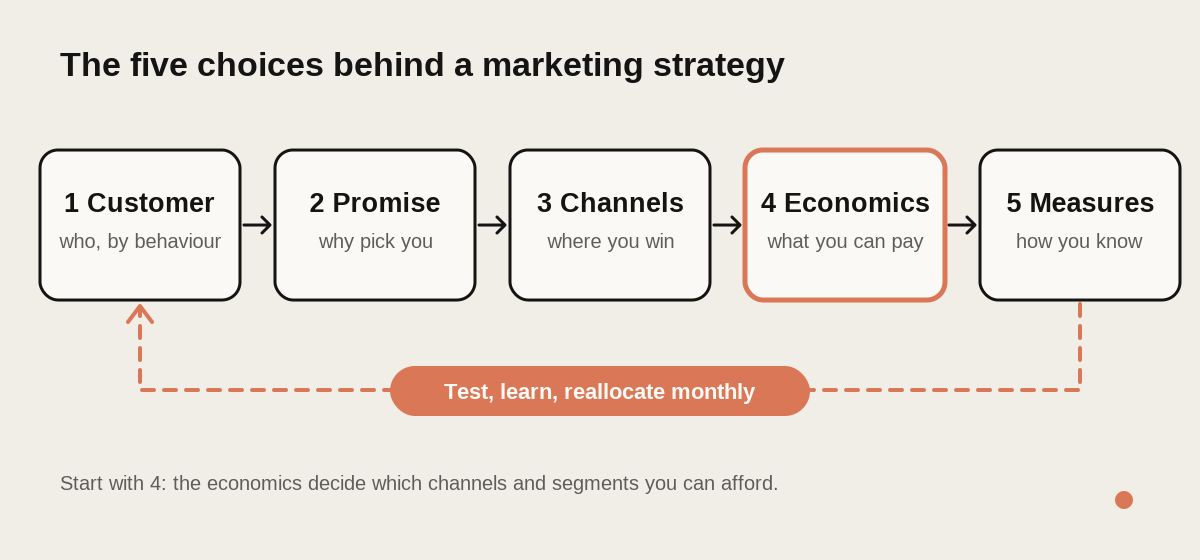
- Who the customer is. One or two segments you can describe by behaviour, not demographics. "People who sell a used phone once every two to three years" is a segment. "Urban millennials" is not.
- The promise. Why they should pick you over the next option, in a sentence a customer would actually say.
- Where you win. The two or three channels where you can reach that segment at a cost the business can carry.
- The economics. What you can afford to pay for a customer and how long it takes to earn it back.
- The measures. A small set of numbers reviewed weekly, with one that matters most.
Strategy, plan and tactics: what's the difference?
People mix these up all the time, and it leads to "strategies" that are really a list of campaigns. Here's how I separate them.
| Strategy | Plan | Tactics | |
|---|---|---|---|
| Answers | Who, why us, where we win | What happens when, with what budget | How each piece is executed |
| Time frame | 12 to 24 months | A quarter or a year | Weeks |
| Changes when | The customer or economics change | Results come in | Every test |
| Example | Win repeat phone sellers in metro cities through search and CRM | Q1: rebuild search accounts, launch a 3-email win-back flow | New headline test on the sell-your-phone ad group |
Step 1: Start from the unit economics
Most strategies start with channels. Start with money instead. Work out the contribution a customer brings in after variable costs, and how much of it you can spend to acquire them. That number decides everything that follows: which channels are viable, how hard you can bid, and how fast you can grow without burning cash.
Here's a worked example for an online store. The numbers are illustrative, so swap in your own.
| Line | Scenario A | Scenario B |
|---|---|---|
| Average order value | ₹2,500 | ₹2,500 |
| Contribution after product, shipping and payment costs | 30% = ₹750 | 30% = ₹750 |
| Orders per customer in 12 months | 2 | 2 |
| 12-month contribution per customer (LTV) | ₹1,500 | ₹1,500 |
| Customer acquisition cost (CAC) | ₹500 | ₹900 |
| LTV to CAC ratio | 3.0 | 1.7 |
| Payback | First order | About 1.2 orders |
Scenario A can grow hard. Scenario B can still grow, but only if repeat purchase improves or acquisition gets cheaper. A 3 to 1 ratio is a common rule of thumb, not a law. A business with fast repeat purchases can run lower, and one with long payback needs more cash in the bank.
At Cashify we grew revenue 72% year on year while keeping customer acquisition cost profitable. The growth came from knowing what a customer was worth in each city and category, then spending up to that line and no further.
Step 2: Pick the segments you'll serve first
You can't market to everyone at once. Score each segment from 1 to 5 on three things: how big the need is, how well your product serves it today, and how cheaply you can reach it. Then pick the top one or two and write down what you're deliberately not doing.
| Segment (illustrative) | Size of need | Fit today | Cheap to reach | Total |
|---|---|---|---|---|
| People upgrading phones every 2 to 3 years | 5 | 4 | 4 | 13 |
| First-time smartphone buyers | 4 | 2 | 3 | 9 |
| Small shops buying stock in bulk | 3 | 3 | 2 | 8 |
The scores are rough, and that's fine. The point is to make the trade-off visible so the team stops trying to please every segment with the same budget.
Step 3: Choose two or three channels to win
Each channel has its own economics and its own job. Pick the ones that match how your chosen segment buys.
| Channel | Best at | Signal to watch | Watch out for |
|---|---|---|---|
| Search ads | Capturing demand that already exists | Cost per acquisition by intent | Paying for your own brand traffic you'd get anyway |
| Paid social and video | Creating demand for things people don't search for | Cost per first purchase, not per click | Creative fatigue after a few weeks |
| SEO and local SEO | Steady, compounding traffic | Clicks and calls from non-brand searches | Slow start: plan for months, not weeks |
| CRM and lifecycle | Turning one purchase into several | Repeat rate and revenue per customer | Over-messaging and unsubscribes |
| Affiliates and partners | Paying only for results | Incremental orders, not attributed orders | Partners claiming sales you'd have made anyway |
For our 200+ stores, hyperlocal SEO was the channel that mattered. Every store needed to win searches from its own neighbourhood, and doing that well delivered steady 10% month-on-month growth in footfall. Paid social would not have done the same job at the same cost.
Step 4: Set the measures before you spend
Pick one north-star number and three to five supporting ones. Agree in advance what result would make you stop or double down. A simple weekly scorecard keeps everyone honest.
| Measure | Type | Target | Owner |
|---|---|---|---|
| Orders from new customers | North star | Set from the plan | Head of growth |
| Customer acquisition cost | Input | At or below the allowed CAC from step 1 | Performance lead |
| Conversion rate, site or app | Input | Up on last month | Product and CRO |
| Repeat rate at 90 days | Input | Up on last quarter | CRM lead |
| Share of revenue from non-paid channels | Health | Rising over time | SEO and CRM |
Step 5: Test, learn and reallocate every month
A strategy is a hypothesis. Run small tests, keep what pays back, and move budget away from what doesn't. A split many teams use is about 70% of budget on proven channels, 20% on scaling promising ones and 10% on new tests. Treat it as a starting point and adjust to your cash position.
When we restructured our Google Ads accounts around this discipline, acquisition cost fell 33%. Funnel and lifecycle work on a D2C brand lifted conversion 25% and cut acquisition cost 14%.
A 90-day rollout plan
| Weeks | Focus | Output |
|---|---|---|
| 1 to 2 | Unit economics and segment scoring | Allowed CAC per segment, top 1 or 2 segments chosen |
| 3 to 4 | Promise and channel choice | One-line promise tested in ads and on the landing page |
| 5 to 8 | Launch in chosen channels, tracking in place | Weekly scorecard live |
| 9 to 12 | First reallocation and review | Budget moved to what pays back; next quarter's tests agreed |
Common mistakes
- Writing a list of tactics and calling it a strategy.
- Choosing channels before knowing what a customer is worth.
- Serving every segment with the same message.
- Measuring clicks and impressions instead of customers and margin.
- Never stopping anything, so budget spreads too thin to work.
- Reviewing the strategy only once a year, long after the numbers changed.
A one-page template you can copy
- Customer: the segment, described by behaviour.
- Promise: one sentence in the customer's words.
- Channels: two or three, each with a target cost per customer.
- Economics: allowed acquisition cost, LTV and payback period.
- Measures: north star plus three to five weekly numbers, each with an owner.
- Not doing: what you're saying no to this quarter.
- Review date: when you'll look at it again.
FAQ
What is a marketing strategy in simple words?
It's the plan for which customers you go after, what you promise them and how you'll reach them profitably. Campaigns are how you carry it out.
What are the main parts of a marketing strategy?
Target customer, value promise, channel choice, unit economics and measures. Some frameworks add pricing and product, which matter just as much if marketing owns them.
How often should a marketing strategy change?
Review the numbers monthly and the strategy each quarter. Change it when the economics or the customer change, not because a new channel is fashionable.
For the paid side of this, read the guide to performance marketing, and see how these choices played out in my case studies.