Growth marketing: how it differs and where to start
Growth marketing looks after the whole customer journey, from first visit to repeat purchase and referral, and uses fast, measured tests to find what grows revenue. Traditional marketing often stops at the first sale. Growth marketing treats that sale as the start.
I grew from a senior executive to General Manager, Growth Marketing and Analytics at Cashify, where revenue grew 72% year on year with profitable acquisition costs. That came from treating acquisition, conversion and retention as one system. This guide shows how that system works, how to run experiments, and a 90-day plan to get started.
In short: pick one north-star metric, map the loop from acquisition to referral, find the weakest link, and run small scored experiments every sprint.
How growth marketing differs from traditional marketing
| Traditional marketing | Growth marketing | |
|---|---|---|
| Scope | Awareness and acquisition | Whole journey: acquire, activate, retain, refer |
| Method | A few big campaigns a year | Many small experiments, kept or dropped on data |
| Measured by | Reach, impressions, leads | Customers, revenue, margin, retention |
| Works with | Agencies and brand teams | Product, data and engineering |
| Planning cycle | Annual | Weekly or fortnightly sprints |
The growth loop
Think of growth as a loop rather than a funnel. New customers arrive, have a good first experience, come back, and bring others. Each turn of the loop makes the next one cheaper. Your job is to find the weakest link and strengthen it.
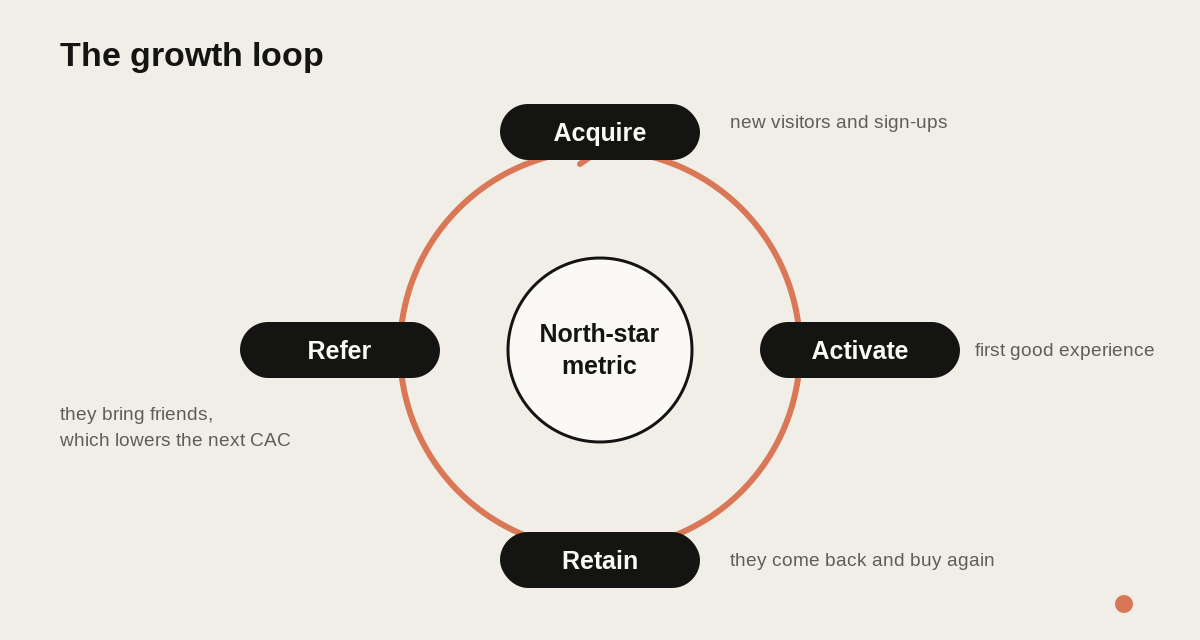
| Stage | The question | Example metric |
|---|---|---|
| Acquire | Are the right people finding us? | New visitors, CAC by channel |
| Activate | Do they get value quickly? | First order rate, time to first value |
| Retain | Do they come back? | Repeat rate at 30 and 90 days, monthly active users |
| Refer | Do they bring others? | Referral rate, reviews per 100 orders |
| Revenue | Is it profitable? | Contribution per customer, payback |
Where to start
1. Fix measurement
You can't run experiments without trustworthy data. Define your events, set up tag management and make sure web and app tracking agree with back-end numbers.
2. Find your north-star metric
Pick the one number that best reflects customers getting value: orders, active users or bookings. Every experiment should aim to move it or one of its inputs.
3. Build and score an experiment backlog
List ideas across every stage of the loop. Score each from 1 to 10 on impact, confidence and ease (often called ICE), then run the highest scores first.
| Idea (illustrative) | Stage | Impact | Confidence | Ease | Score |
|---|---|---|---|---|---|
| Show delivery date on product pages | Activate | 7 | 7 | 9 | 23 |
| Win-back email at day 60 | Retain | 6 | 8 | 8 | 22 |
| Ads in two regional languages | Acquire | 8 | 6 | 6 | 20 |
| Refer-a-friend credit | Refer | 7 | 5 | 4 | 16 |
4. Run each experiment properly
Use the same short template every time:
- Hypothesis: if we do X for audience Y, metric Z will move by about N.
- Metric: one primary metric and one guardrail metric (for example conversion rate and refund rate).
- Size and duration: enough traffic to tell a real change from noise; usually at least one full week to cover weekday patterns.
- Decision rule: written before launch: what result means ship, iterate or drop.
- Learning: one line in a shared log, win or lose.
5. Make acquisition efficient
Restructure paid accounts around intent and customer value. Doing this on Google Ads cut our acquisition cost by 33%. The performance marketing guide covers this in detail.
6. Invest in retention
Lifecycle automation and remarketing drove 30% average month-on-month growth in monthly active users. Retention compounds; acquisition doesn't.
7. Go local where it matters
For businesses with physical stores, hyperlocal SEO and local acquisition can be the biggest lever. It delivered 10% month-on-month footfall growth across 200+ stores for us.
What this looks like in results
| Lever | Result |
|---|---|
| Whole-funnel growth programme | Revenue up 72% year on year, with profitable CAC |
| Google Ads restructure | CAC down 33% |
| Lifecycle automation and remarketing | Monthly active users up 30% a month on average |
| Vernacular campaigns | New-user acquisition up 27%, CTR up 4% |
| D2C funnel and lifecycle work | Conversion up 25%, CAC down 14% |
| Hyperlocal SEO for 200+ stores | Footfall up 10% a month |
Your first 90 days
| Days | Focus | Output |
|---|---|---|
| 1 to 30 | Measurement and baseline | Tracking audit, north-star metric, loop mapped with current rates |
| 31 to 60 | First experiments | Backlog scored; 4 to 6 experiments run on the weakest stage |
| 61 to 90 | Scale and systemise | Winners rolled out; weekly growth meeting and learning log in place |
Skills a growth marketer needs
- Analytics and comfort with data.
- Paid acquisition across search, social and partners.
- Lifecycle, CRM and email.
- Experiment design and reading results honestly.
- Enough product sense to work with designers and engineers.
- A clear view of unit economics (see the marketing strategy guide).
Common mistakes
- Running experiments without a decision rule, so every result looks like a win.
- Chasing acquisition while the product loses customers after the first order.
- Testing tiny changes that can't move the north-star metric.
- Not writing down what failed, so the team repeats it.
- Treating growth as a team's job instead of a shared way of working.
FAQ
What is growth marketing in simple words?
It's marketing that looks after the whole customer journey and uses quick, measured tests to grow revenue, not just to win first-time customers.
Is growth marketing the same as growth hacking?
Growth hacking was an early label for quick, scrappy experiments. Growth marketing keeps the testing mindset but adds discipline on economics, brand and retention.
What does a head of growth do?
They own the growth targets, set the experiment agenda across acquisition and retention, manage the budget and work with product and data teams to move the north-star metric.
Read more about my background on the about page and the results in my case studies.