Marketing funnel: stages, metrics and how to fix leaks
A marketing funnel maps how people move from first hearing about you to buying and coming back. Its real value is diagnostic: it shows where people drop off, so you fix the stage that costs you the most customers instead of spending more at the top.
This guide covers the stages, the metrics for each, a worked example of finding the leak worth fixing first, and a lifecycle plan for the bottom of the funnel.
In short: measure the rate between each stage, work out which stage would add the most customers if improved, fix that one first, and don't stop at the first purchase.
The stages of a marketing funnel
- Awareness: people learn you exist, through search, social, video, partners, word of mouth or a store they walk past.
- Consideration: they compare you with other options, read reviews and visit product pages.
- Conversion: they buy, book, sign up or submit a lead.
- Retention: they come back, use the product again and buy more.
- Advocacy: they recommend you, review you or refer friends.
Many teams stop at conversion. For marketplaces and D2C brands, retention is often where most of the profit sits.
Metrics for each stage
| Stage | Key metrics | Where to find them |
|---|---|---|
| Awareness | Reach, impressions, branded search volume, share of search | Ad platforms, Search Console, Google Trends |
| Consideration | Product page views, time on page, add-to-cart or enquiry rate | Web and app analytics |
| Conversion | Conversion rate, cost per acquisition, average order value | Analytics, back-end orders |
| Retention | Repeat purchase rate, monthly active users, churn | CRM, back-end data |
| Advocacy | Referral rate, review count and rating | Review platforms, referral tool |
Track the rate between each stage, not just the totals. A drop from 8% to 5% add-to-cart tells you far more than "sales were down".
How to find the leak worth fixing first
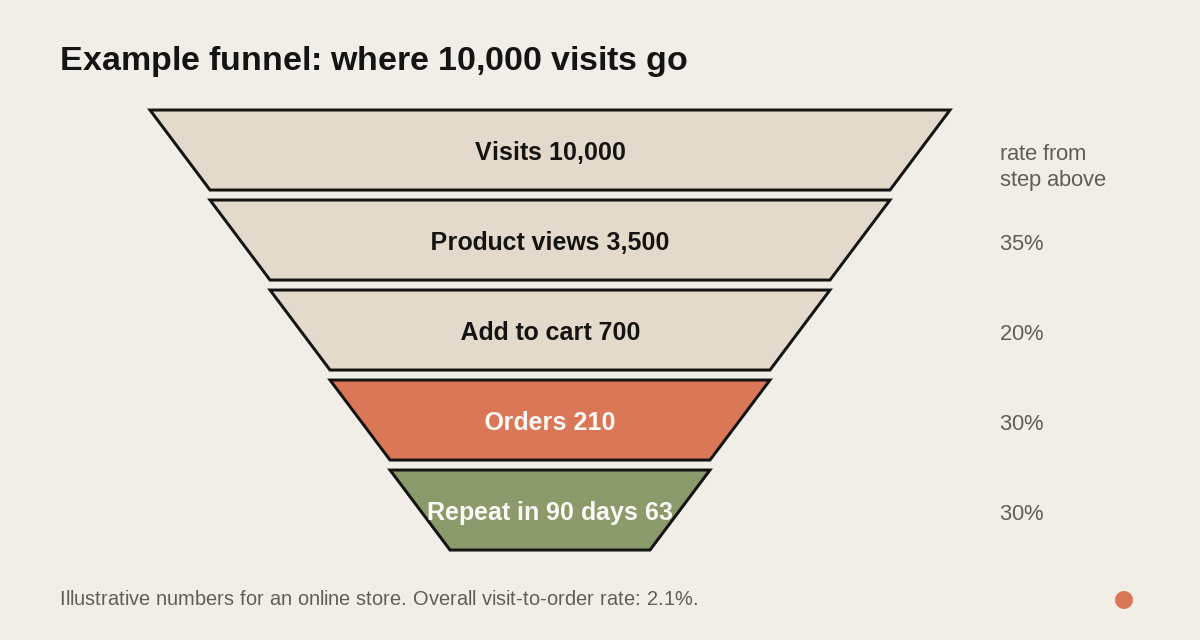
Take the example funnel above: 10,000 visits a month and 210 orders. Now ask what happens if you improve each stage by a realistic amount, one at a time.
| Change (one at a time) | New numbers | Orders | Extra orders | Cost of the change |
|---|---|---|---|---|
| Product view rate 35% → 40% | 4,000 views, 800 carts | 240 | +30 | Better category pages and search |
| Add-to-cart rate 20% → 24% | 3,500 views, 840 carts | 252 | +42 | Clearer price, delivery and reviews on product pages |
| Checkout rate 30% → 36% | 700 carts | 252 | +42 | Fewer form fields, more payment options |
| 10% more traffic, same rates | 11,000 visits | 231 | +21 | About 10% more media budget |
Two stages tie for the biggest gain, and both beat buying more traffic. That's the usual pattern: fixing a leak is cheaper than pouring more in at the top. Pick the cheaper of the two fixes and start there.
Diagnose the leak before you fix it
| Symptom | Likely cause | First thing to try |
|---|---|---|
| High traffic, few product views | Wrong audience or weak landing page | Match ad message to landing page; check targeting |
| Product views but few add-to-carts | Price, trust or missing information | Show delivery date, returns policy, reviews near the price |
| Carts but few orders | Checkout friction or surprise costs | Show total cost early, guest checkout, local payment methods |
| Good on desktop, poor on mobile | Slow or awkward mobile pages | Test page speed and tap targets on a mid-range phone |
| Good first orders, few repeats | No reason or reminder to come back | Post-purchase lifecycle flow (below) |
Always split the numbers by device, channel and new versus returning visitors. Leaks usually hide in one segment, such as mobile users from paid social. Funnel work on a D2C brand, done this way, lifted conversion 25% and cut acquisition cost 14%.
Use lifecycle marketing for the bottom of the funnel
Automated messages after the first purchase, reminders and win-back campaigns keep customers moving. Lifecycle automation and remarketing delivered an average of 30% month-on-month growth in monthly active users at Cashify. A simple starting sequence:
| When | Message | Goal |
|---|---|---|
| Day 0 | Order confirmation with what happens next | Reduce worry and support calls |
| Day 3 | How to get the most from the product | Get them using it |
| Day 14 | Ask for a review | Social proof for the next buyer |
| Day 30 | Related product or upgrade offer | Second purchase |
| Day 60 | Win-back with a reason to return | Recover people going quiet |
Speak the customer's language, too. Vernacular campaigns lifted click-through rate 4% and new-user acquisition 27% for us.
The funnel for offline and omnichannel businesses
Stores have funnels too. Awareness comes from local search and maps, consideration from reviews and directions, conversion from the visit. Hyperlocal SEO for 200+ stores drove consistent 10% month-on-month footfall growth by improving the very first step: being found nearby. Track calls, direction requests and store visits from your business profiles as your funnel metrics.
Common mistakes
- Pouring more budget into awareness when the leak is at checkout.
- Treating all traffic the same instead of splitting by channel and device.
- Ignoring retention because it doesn't show up in this month's acquisition numbers.
- Measuring stages with different date ranges or definitions.
- Changing three things on a page at once, so you can't tell what helped.
FAQ
What are the 4 or 5 stages of a marketing funnel?
Awareness, consideration, conversion and retention, with advocacy often added as a fifth stage.
What is the difference between a marketing funnel and a sales funnel?
The marketing funnel covers how people discover and consider you. The sales funnel focuses on turning interested prospects into paying customers, often with a sales team involved.
What is a good funnel conversion rate?
It varies too much by industry, price and traffic source for one number to help. Compare each stage with your own last month and with each traffic source, and work on the biggest gap.
For the paid traffic that feeds the funnel, read the performance marketing guide. See how these fixes worked in practice in my case studies.