AI in digital marketing: where it pays off today
AI in digital marketing pays off fastest where it saves time on work you already do: bidding and budget allocation, creative testing, reporting and analysis, and lifecycle messaging. The returns are slower and riskier when teams use it to replace thinking about customers, positioning or economics.
I use AI tools daily in paid media and marketing operations. Using AI to scale large ad accounts and run quality checks improved click-through rate by 15% and cut acquisition cost by 5% for us. This guide shows where to start, how to set guardrails, how to run a fair pilot and how to measure whether it paid off.
In short: start with low-risk, repetitive work you can measure, run AI side by side with your current method for four weeks, and keep people in charge of goals, claims and customer data.
Where AI fits: a simple map
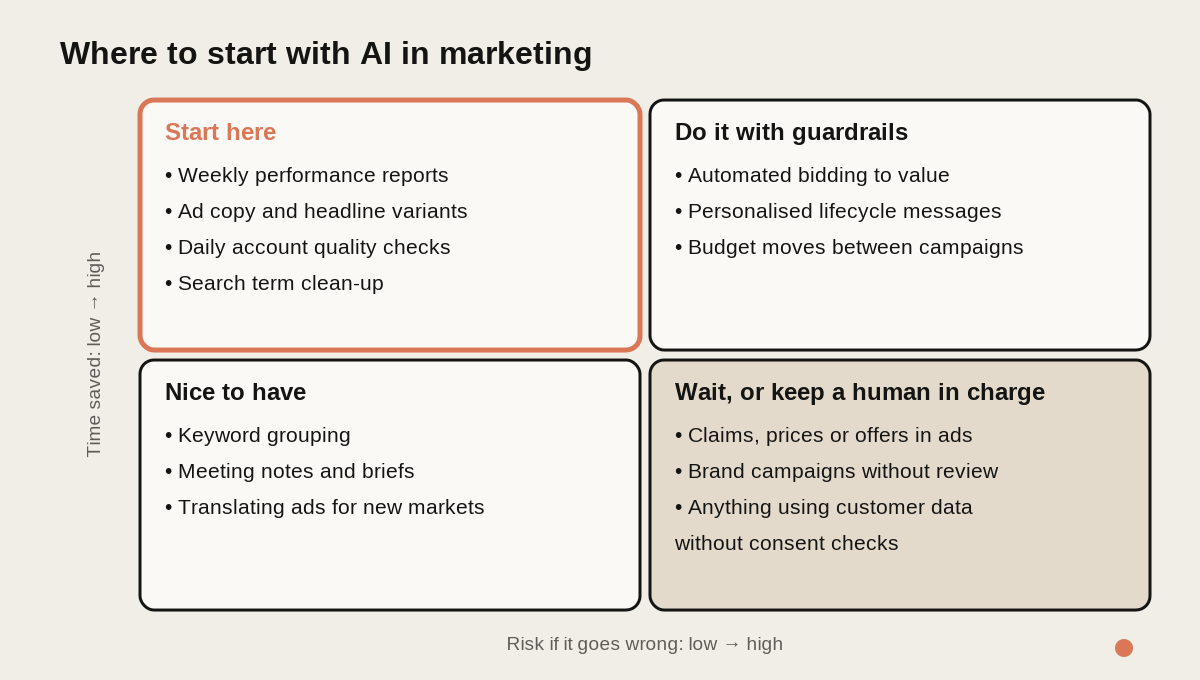
Where AI helps most today
| Use case | What AI does | Time saved | Risk | Start here? |
|---|---|---|---|---|
| Reporting and analysis | Reads ad and analytics data, flags changes, explains them in plain words | High | Low | Yes |
| Ad copy and creative variants | Drafts headlines, descriptions and image ideas to widen tests | High | Medium | Yes, with review |
| Account quality checks | Finds broken links, disapproved ads, wasted search terms, capped budgets | High | Low | Yes |
| Bidding and budgets | Sets bids and moves budget toward conversions | High | Medium | Yes, with clean data |
| Lifecycle and CRM | Predicts who will buy again or churn; times messages | Medium | Medium | After basics work |
| Content and SEO | Drafts outlines, FAQs and briefs | Medium | Medium | With human editing |
1. Reporting and analysis
Assistants that read your ad and analytics data can spot shifts in cost, conversion or audience overnight and explain them. That frees analysts for decisions instead of spreadsheets. A useful weekly prompt: "Compare last week with the week before by campaign. List the three biggest changes in CAC, say which metric drove each (CPC or conversion rate), and suggest one action for each."
2. Creative testing at scale
Use AI to widen the test, then let real results pick the winners. A workflow that works:
- Give it the product facts, the audience and your brand rules.
- Ask for 10 headline variants across different angles: price, speed, trust, convenience.
- A person removes anything untrue, off-brand or risky.
- Launch 3 to 5 in a proper test and keep the winner for the next round.
3. Account quality checks
Large accounts drift: broken links, disapproved ads, wasted search terms, budgets capped on winners. AI checks catch these daily instead of monthly. This is where much of our 15% click-through improvement came from.
4. Bidding and budget allocation
Ad platforms already run machine learning for bids. Your job is to feed them clean conversion data, sensible goals and enough budget per campaign to learn. Most gains come from better inputs, not more settings. See the performance marketing guide for the numbers to set as targets.
5. Lifecycle and CRM
Models that predict who is about to churn or buy again let you send the right message at the right time. Lifecycle automation of this kind delivered 30% average month-on-month growth in monthly active users at Cashify.
6. Search and AI answers
More people now ask AI assistants instead of typing searches. Pages that answer the question in the first lines, use clear headings, tables and FAQs, and show who wrote them are easier for both search engines and AI assistants to use and cite.
Guardrails before you scale
| Risk | What goes wrong | Guardrail |
|---|---|---|
| Bad data | AI optimises confidently toward the wrong goal | Check tracking weekly against back-end orders |
| Made-up claims | Copy promises prices, features or results you don't offer | Human review of every claim before launch |
| Brand drift | Tone slowly moves away from your brand | Short brand rules in every prompt; spot checks |
| Privacy | Customer data used without consent | Only use consented data; follow local rules |
| Over-automation | Nobody notices when spend goes wrong | Daily spend alerts and a named owner per account |
A 4-week pilot plan
| Week | What to do | What to measure |
|---|---|---|
| 1 | Pick one task; record how long it takes now and its results | Baseline hours and KPI |
| 2 | Run AI alongside the current method on half the work | Hours, quality, errors caught |
| 3 | Keep running; fix the prompt and review steps | Same, plus team feedback |
| 4 | Compare both halves and decide: keep, change or drop | Hours saved, KPI change, risks seen |
How to tell if it paid off
Count two things: time saved and performance change. Say AI reporting saves an analyst 6 hours a week. That's roughly 300 hours a year back for analysis and testing. If the extra tests lift conversion even slightly, the gain adds up across every rupee of spend. If time saved is real but results got worse, stop and fix the inputs before going further.
Common mistakes
- Starting with the riskiest use case because it sounds impressive.
- Letting AI write ads with no human check on claims.
- Automating bids on top of broken conversion tracking.
- Measuring time saved but not results, or the other way round.
- Rolling out to every account at once instead of piloting.
FAQ
How is AI used in digital marketing?
For automated bidding, generating and testing creative, analysing performance data, personalising emails and messages, and spotting account issues early.
Will AI replace digital marketers?
It replaces repetitive tasks, not judgment. Marketers who know their customers and economics, and use AI to move faster, become more valuable.
What is the best first AI use case for a marketing team?
Performance reporting or ad copy variants. Both are low risk, easy to measure and save hours every week.
The daily Growth Stack briefing tracks new AI tools for marketers as they launch.