Hotel direct booking strategy: a numbers-first plan
A hotel direct booking strategy is a plan to win more stays through your own website, phone and email, where you keep most of the room rate, instead of paying commission to an OTA (online travel agency) for each one. The goal isn't zero OTA bookings: it's knowing what every channel costs per stayed booking and moving guests to the cheapest channel that still fills rooms.
This guide starts with the money: what a ₹12,000 booking leaves you on each channel, the most you can pay to win it direct, and how a modest shift in mix pays for the work. Every number in the examples is illustrative, so put in your own.
In short: a direct booking isn't free, it's cheaper. Work out what each channel keeps from the same booking after commission, ad spend, card fees and any perks. The gap between your OTA cost and your direct extras is the most you can spend to win a booking direct. Spend below it, and grow the free channels first.
Where hotel bookings come from, and what each one costs
List every way a guest can book you and how you pay for it. An OTA takes a share of each booking; ads charge per click whether or not anyone books.
| Channel | How you pay | Guest data you keep |
|---|---|---|
| OTA (Booking.com, Expedia, MakeMyTrip and similar) | Commission: a share of each booking, set in your contract | Limited; the OTA owns the relationship |
| Paid search and metasearch (sites that compare hotel prices, such as Google's hotel results) | Usually per click, so you pay for visits that don't book too | Full, once they book on your site |
| Google free booking links | Nothing per click | Full |
| Organic search and your Google Business Profile | Time and content, no media cost | Full |
| Email and repeat guests | Sending costs and any offer you give | Full |
Two Google changes matter now. Free booking links let your own booking site appear next to OTAs in Google's hotel results at no cost per click. And Google says that from Q4 2026 Hotel campaigns will migrate to new Search campaigns for Travel, so check your account notifications before you plan any paid hotel ads.
Worked example: what one ₹12,000 booking keeps (illustrative)
A 40-room hotel sells a two-night stay at an ADR (average daily rate, the average room revenue per occupied room per night) of ₹6,000, so the booking is worth ₹12,000 before taxes. Work on room revenue net of GST (India's goods and services tax), because the tax was never yours; the GST calculator helps if your rates include it.
The assumptions: the OTA contract is 18% commission and the OTA collects payment. Any tax charged on the commission is left out here, so check that with your accountant. Direct bookings pay a 2% card fee and get free breakfast as a book-direct perk, which costs the hotel ₹250 per night. Paid clicks cost ₹25 each and 1 in 40 clicks books (a 2.5% conversion rate), so ads cost ₹1,000 per booking. A repeat guest is won back by an email costing about ₹50 per booking, tool and offer included.
| Channel | Costs on a ₹12,000 booking | Total cost | You keep |
|---|---|---|---|
| OTA | ₹2,160 commission (18%) | ₹2,160 | ₹9,840 |
| Paid direct (search or metasearch ads) | ₹1,000 ads + ₹240 card fee + ₹500 breakfast | ₹1,740 | ₹10,260 |
| Free direct (free booking link, organic, brand search) | ₹240 card fee + ₹500 breakfast | ₹740 | ₹11,260 |
| Repeat guest by email | ₹50 email + ₹240 card fee + ₹500 breakfast | ₹790 | ₹11,210 |
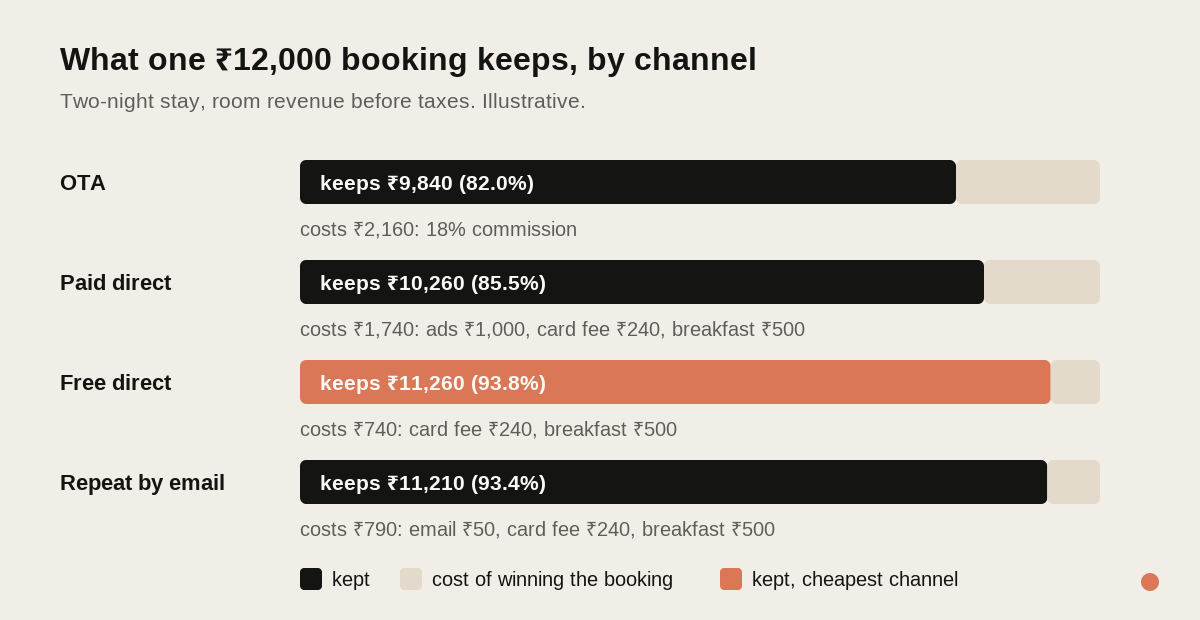
Look at the second row: paid direct beats the OTA by only ₹420 a booking, because clicks and perks add up. The real prize is the free rows: each booking moved from an OTA to a free booking link, organic search or a returning guest keeps ₹1,370 to ₹1,420 more.
That's the trunk of everything on this site: growth that pays for itself. A channel earns its budget by what it keeps per stayed booking, not by how much traffic it brings. I work on travel brands across 10+ markets, and I often see the same pattern: hotels overspend on paid clicks and underinvest in the free channels they already own.
Your break-even cost per direct booking
The most you can pay to win a direct booking is what the OTA would have cost, minus the extras a direct booking brings. Spend more than that and you'd have been better off letting the OTA have it.
| Measure | Formula | In the example |
|---|---|---|
| Break-even cost per booking | OTA commission − card fee − direct perk | ₹2,160 − ₹240 − ₹500 = ₹1,420 |
| Break-even CPC (cost per click) | Break-even cost per booking × conversion rate | ₹1,420 × 2.5% = ₹35.50 |
| Break-even ROAS (return on ad spend: booking value ÷ ad spend) | Booking value ÷ break-even cost per booking | ₹12,000 ÷ ₹1,420 = 8.45 |
| Your actual ROAS | Booking value ÷ ad cost per booking | ₹12,000 ÷ ₹1,000 = 12.0 |
Read it this way: if your actual ROAS is above your break-even ROAS (8.45 here), paid direct earns more than the OTA would; below it, you lose money on each booking. At ₹25 a click you're under the ₹35.50 ceiling, so paid direct is worth keeping. If clicks rose to ₹40 at the same conversion rate, each booking would cost ₹1,600 in ads and lose ₹180 against the OTA. Put your own booking value and ad cost into the ROAS calculator and compare its answer with your break-even ROAS.
Two cautions. First, compare stayed bookings. Ad spend is paid whether or not the guest turns up, so if 20% of paid direct bookings cancel, its ad cost per stay is ₹1,000 ÷ 0.8 = ₹1,250. OTA commission is often charged only on completed stays, so check your contract before you apply the same rule to it. Second, some paid clicks come from people who'd have booked direct anyway, often on your own hotel name; test a short pause on brand terms before you trust the ROAS. When I restructured Google Ads at Cashify, CAC (customer acquisition cost) fell 33%, and that kind of result starts with knowing what each click is really worth.
Five levers that grow direct bookings
Work on the free levers first, then paid. Each has a number that shows if it's working.
| Lever | What to do | What it costs | The number to watch |
|---|---|---|---|
| 1. Own your name in search | Complete your Google Business Profile, keep photos and prices current, and make sure your own site ranks first for your hotel name | Time | Share of brand-name clicks that reach your site |
| 2. Turn on free booking links | Connect through Google Hotel Center (Google's free tool for sending your rates) or ask your booking engine (the system that takes bookings on your site) or channel manager (the tool that syncs rates to every channel) if they already connect you | Usually none per click | Clicks and bookings in Hotel Center reports |
| 3. Fix the booking engine | Test booking on a phone: fewer steps, clear total price, no surprise fees | Developer or vendor time | Booking engine conversion rate |
| 4. Give a reason to book direct | Add value (breakfast, late checkout, a flexible rate) rather than a lower price, within your OTA contract | The perk's cost per booking | Direct share of bookings |
| 5. Bring past guests back | Email past direct guests before their usual travel season with a member offer | Email tool and offer | Repeat bookings per 100 past guests |
On lever 2, Google ranks free booking links on signals such as value to the user, landing page experience and how accurate your prices have been under its Price Accuracy Policy. Google says no one can pay for a higher free ranking, so the work is keeping rates and availability in sync.
On lever 4, many OTA contracts include rate parity terms that limit how much cheaper your own site can be, so read yours before you discount. A perk is usually the safer reason to book direct.
Lever 5 is where the CRM (customer relationship management) work pays off. My CRM and lifecycle marketing guide shows how to segment past guests and prove the lift with a holdout group (past guests who don't get the email, so you can see what would have happened anyway).
What a small shift in mix is worth
Back to the 40-room hotel. At 70% occupancy over 30 days it sells 840 room nights, which is 420 two-night bookings a month worth ₹50,40,000 (₹50.4 lakh). Here's the same month with 10 points of bookings moved from the OTA to direct channels, using the costs per booking from the table above. Today's mix is 70% OTA, 10% paid direct and 20% free direct; the plan is 60%, 15% and 25%.
| Channel (cost per booking) | Today | Plan |
|---|---|---|
| OTA (₹2,160) | 294 bookings: ₹6,35,040 | 252 bookings: ₹5,44,320 |
| Paid direct (₹1,740) | 42 bookings: ₹73,080 | 63 bookings: ₹1,09,620 |
| Free direct (₹740) | 84 bookings: ₹62,160 | 105 bookings: ₹77,700 |
| Total cost | 420 bookings: ₹7,70,280 | 420 bookings: ₹7,31,640 |
The plan saves ₹38,640 a month, or ₹4,63,680 a year, with no extra guests at all. It assumes the guests you move would still have booked, and that free channels can take 21 more bookings a month at the same cost, so treat it as a target to test, not a forecast. It also uses costs per booking before cancellations, to keep the sums simple. If fixing the booking engine and setting up free booking links costs ₹1,50,000 up front, it pays back in about four months (₹1,50,000 ÷ ₹38,640 = 3.9). That's the test for every direct booking project: what it costs, what it saves per month and how fast it pays back. My unit economics guide uses the same payback logic for orders.
How to build your direct booking strategy, step by step
- Pull the last 12 months of bookings by channel from your PMS (property management system) or channel manager: bookings, room revenue, cancellations and length of stay.
- Write down each channel's real cost per booking: commission rates from your contracts, ad spend divided by bookings, card fees and the cost of any perks.
- Convert to cost per stayed booking by dividing by each channel's stay rate (1 minus its cancellation rate).
- Work out your break-even cost per direct booking and break-even CPC.
- Check the free levers: brand search, Google Business Profile, free booking links and the booking engine on a phone.
- Tag every link you control (email, social, partner sites) with UTM parameters (short tags added to a link that tell your analytics where a visit came from) so direct bookings are counted by source.
- Pick one lever per month, set the number you expect it to move, and review it after four weeks.
An AI assistant can do steps 1 to 3 for you: give it the channel exports with names and emails removed and ask it to "build a table of cost per stayed booking by channel and month, and flag any month where a channel's cost rose more than 20%". Check every formula before you act on it, and never paste guest personal data into a tool your hotel hasn't approved.
A 90-day plan
| Days | Focus | Done when |
|---|---|---|
| 1–30 | Measure: cost per stayed booking by channel, break-even CPC, booking engine tested on a phone, UTM tags on all owned links | One sheet shows what each channel keeps per booking |
| 31–60 | Free channels: Google Business Profile complete, free booking links live, booking engine fixes shipped, book-direct perk shown on every rate page | Free direct bookings tracked weekly |
| 61–90 | Paid and repeat: cap bids at your break-even CPC, test a brand-term pause, send the first past-guest email with a holdout group | Direct share and saving per month compared with day 1 |
Measure free booking links separately: Google lets you add a landing page variable that shows whether a click came from an ad or a free booking link, and the UTM builder does the same for your emails and social posts.
Common mistakes
- Cutting the OTA too hard. OTAs bring guests who'd never find you; aim for a better mix.
- Bidding above break-even. A paid direct booking that costs more than the OTA would have is a loss, however good the ROAS looks.
- Counting brand clicks as new demand. Many people searching your hotel's name would book direct anyway.
- Ignoring cancellations. A channel with cheap bookings and high cancellations can cost more per stay.
FAQ
What is a good direct booking share for a hotel?
There's no single benchmark; it depends on location, guest mix and whether you're part of a chain with a loyalty scheme. Track your own trend: a rising direct share with flat or falling cost per stayed booking means it's working.
Do Google free booking links cost anything?
No. Google says there's no cost for clicks on free booking links and that payment can't buy a higher free ranking. You need rates, availability and a landing page connected through Hotel Center, often via your booking engine or channel manager.
Should a hotel stop using OTAs?
Rarely. OTAs are a paid channel with a known cost per booking and wide reach. Keep them for guests you can't win more cheaply, and move repeat and brand-aware guests to direct channels.
Try this week
- Fill in the worked-example table with one recent booking from each channel and your own costs.
- Work out your break-even CPC and compare it with last month's average CPC on your paid hotel and search campaigns.
- Book a room on your own site using your phone and count the steps. Fix the worst one first.
Free tools for this guide
- ROAS calculator: check paid direct bookings against your break-even ROAS.
- Pricing and unit economics calculator: see what a booking keeps from GBV (gross booking value) after commission, discounts and costs.
- Google Business Profile tools: tidy the listing that wins your brand searches.
- UTM builder: tag email, social and partner links so direct bookings are counted by source.
Next step
Every booking you move off an OTA puts more of the room rate back in the hotel's pocket. Run your own booking through the ROAS calculator and compare it with your break-even ROAS. Then read the unit economics guide to see the full cost of each booking, and get one new idea like this every week in the weekly digest.